
22nd Annual Northeast Lean Conference · Recap
Standard Work 2.0™ | Northeast LEAN Conference Recap
The full slide deck from my session at the 22nd Annual Northeast Lean Conference: how to bring AI onto a regulated shop floor with the same discipline Lean brought to the physical one, so automation removes the Hidden Factory instead of building a second one.
PDF · 13 slides · 0.8 MB · free, no form
- Session
- Standard Work 2.0™: Engineering the Human-in-the-Loop AI Strategy
- Conference
- 22nd Annual Northeast Lean Conference (GBMP)
- Date
- September 30, 2026
- Location
- Springfield, MA
Session recording
Watch the talk
The full session, start to finish, including the Friday Morning Action Plan and the room's questions.
Recording in post-production
The session video publishes here shortly. Until then, the full deck is a free download above, and every slide is summarized below.
Inside the deck
The talk, slide by slide
Each slide carries one idea. Together they map Lean's oldest disciplines onto the newest source of waste on the floor: unstructured AI.
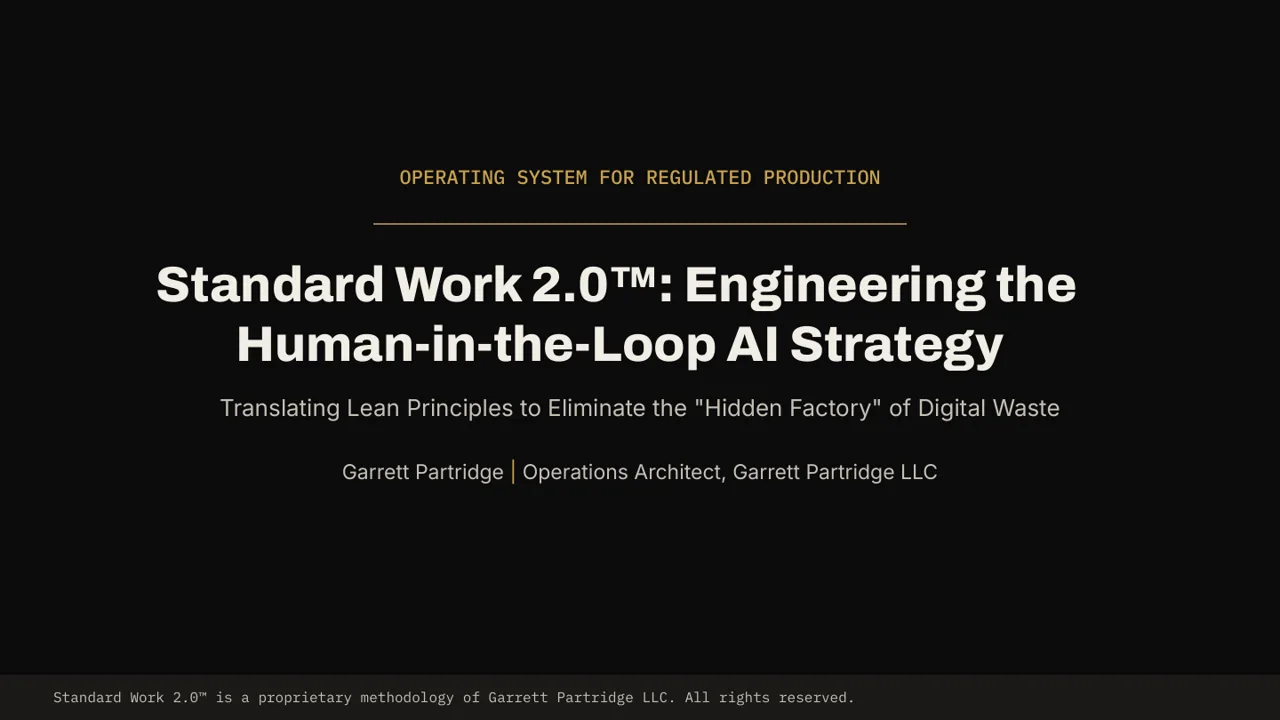
01 · Operating system for regulated production
Engineering the human-in-the-loop AI strategy
Translating Lean principles to eliminate the Hidden Factory of digital waste.
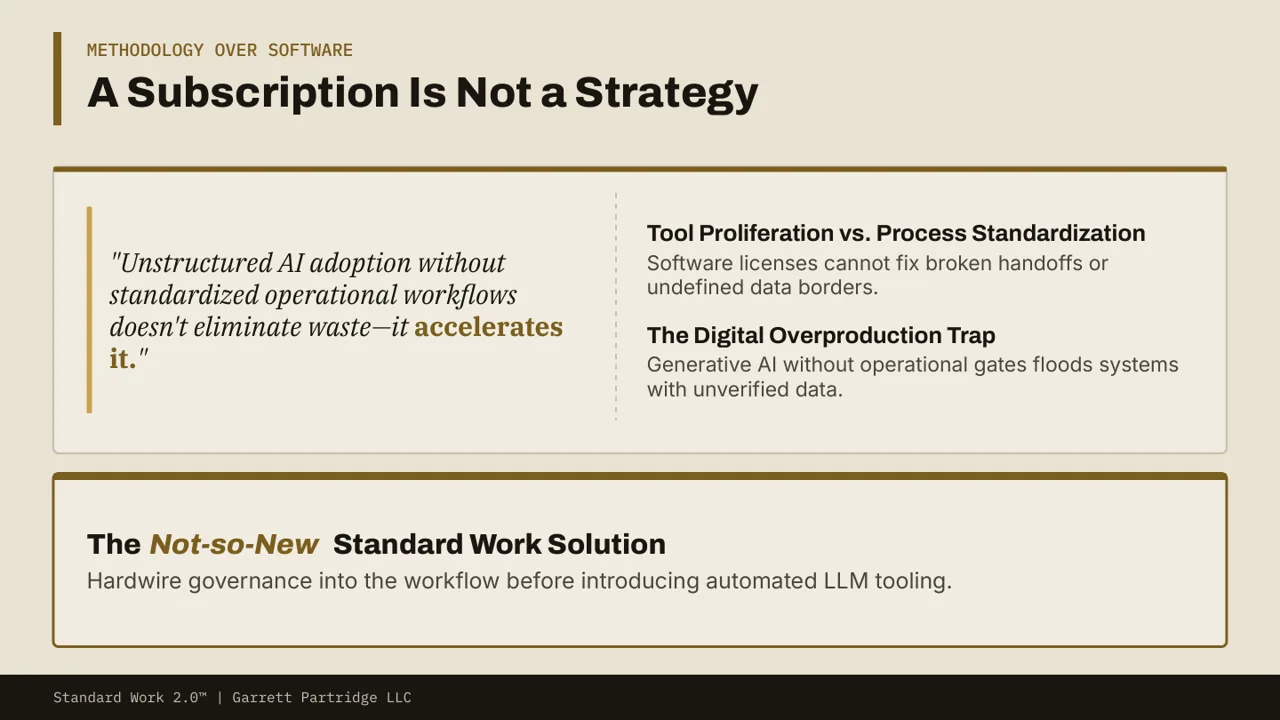
02 · Methodology over software
A subscription is not a strategy
Unstructured AI adoption accelerates waste. Governance gets hardwired into the workflow before any LLM tooling arrives.
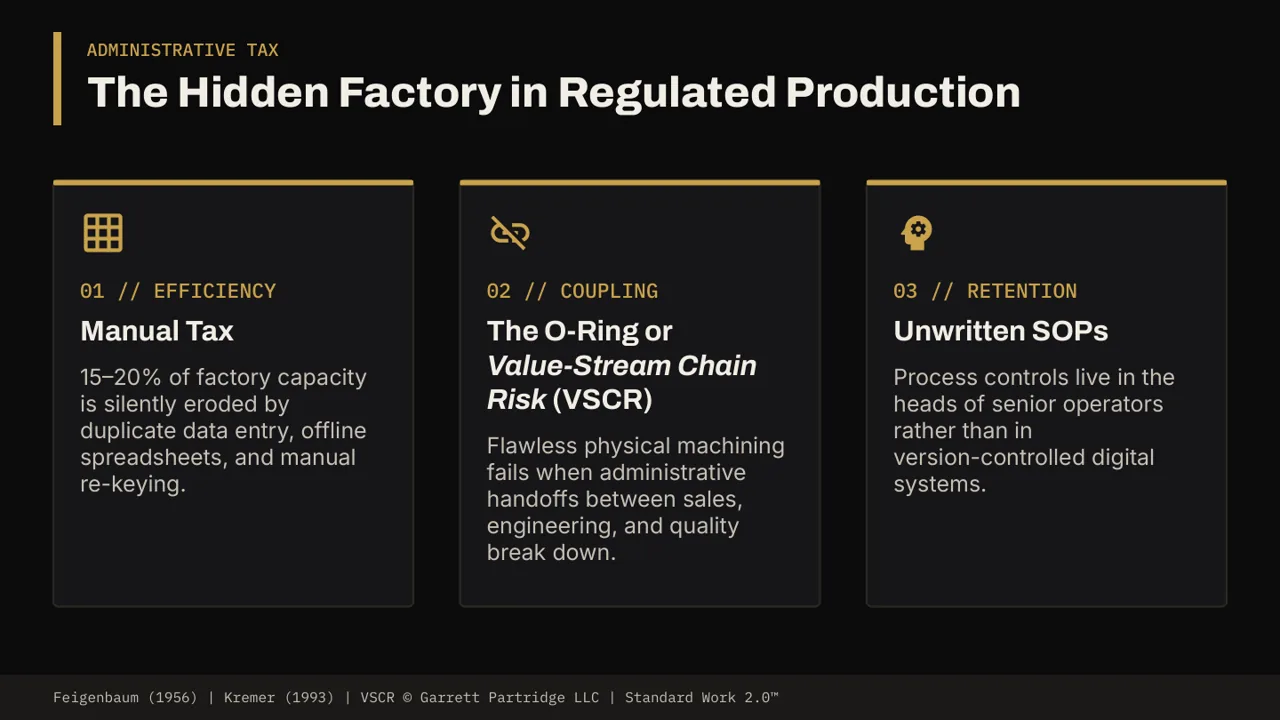
03 · Administrative tax
The Hidden Factory in regulated production
15 to 20% of factory capacity erodes into duplicate entry, offline spreadsheets, and manual re-keying.
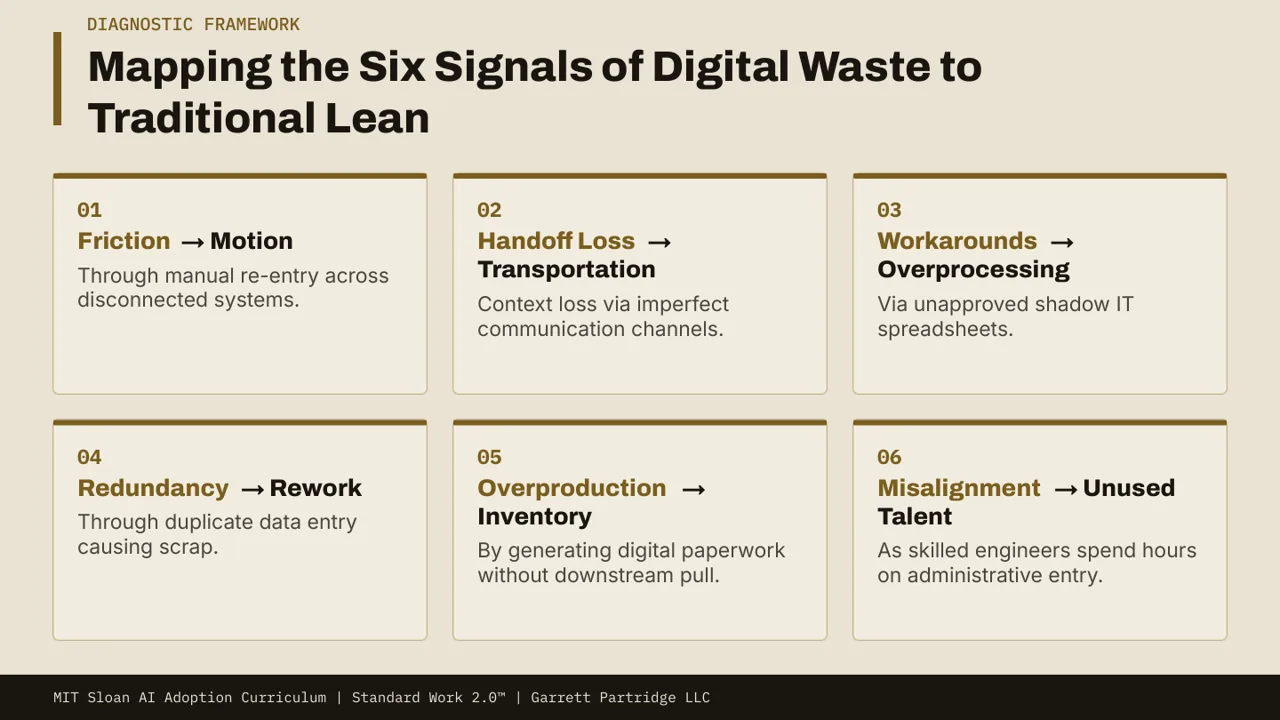
04 · Diagnostic framework
Six signals of digital waste, mapped to Lean
Friction to motion, handoff loss to transportation, workarounds to overprocessing, redundancy to rework, overproduction to inventory, misalignment to unused talent.
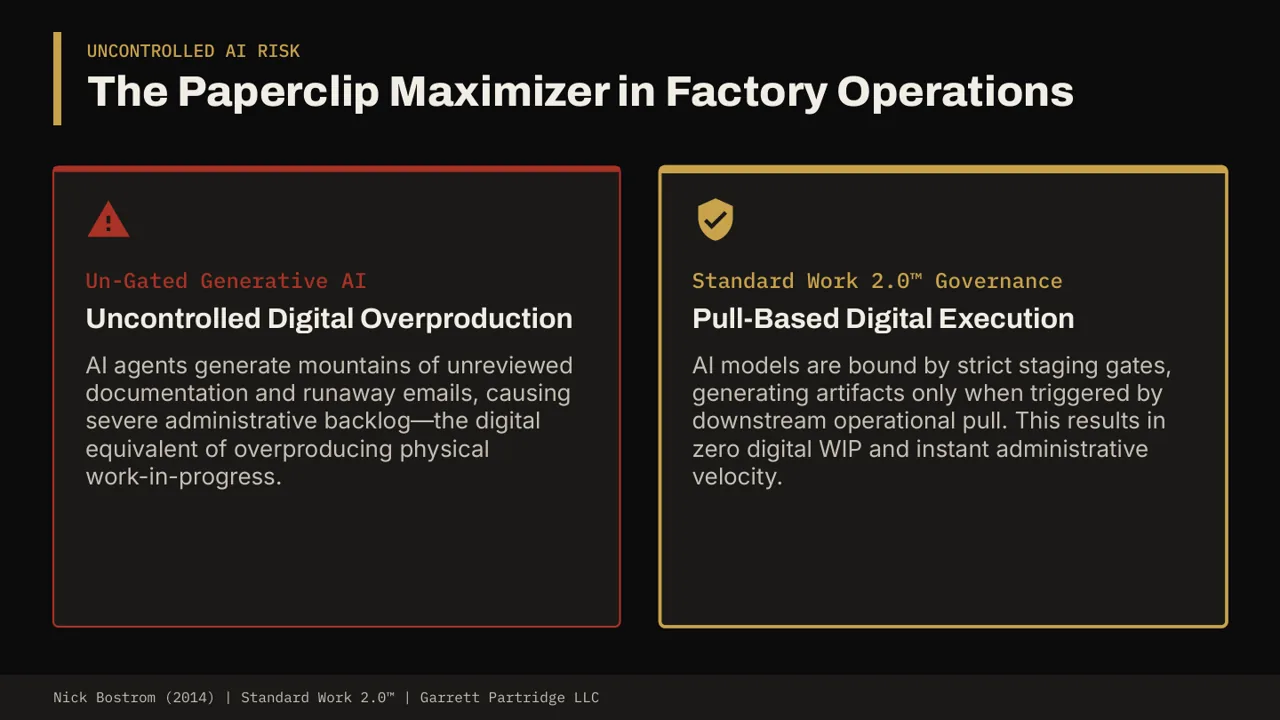
05 · Uncontrolled AI risk
The Paperclip Maximizer in factory operations
Un-gated AI floods the office with unreviewed documents. Pull-based staging gates hold digital work-in-progress at zero.
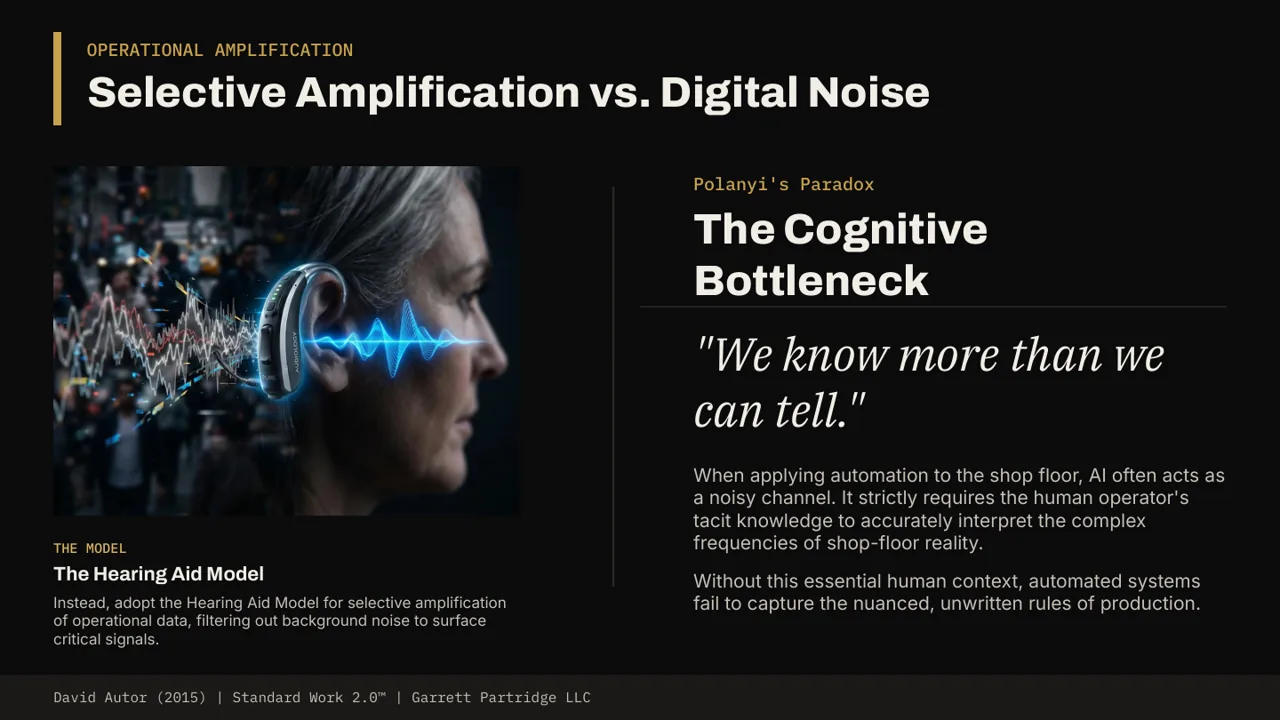
06 · Operational amplification
Selective amplification vs. digital noise
The Hearing Aid Model: AI amplifies the signal, and the operator's tacit knowledge interprets it.
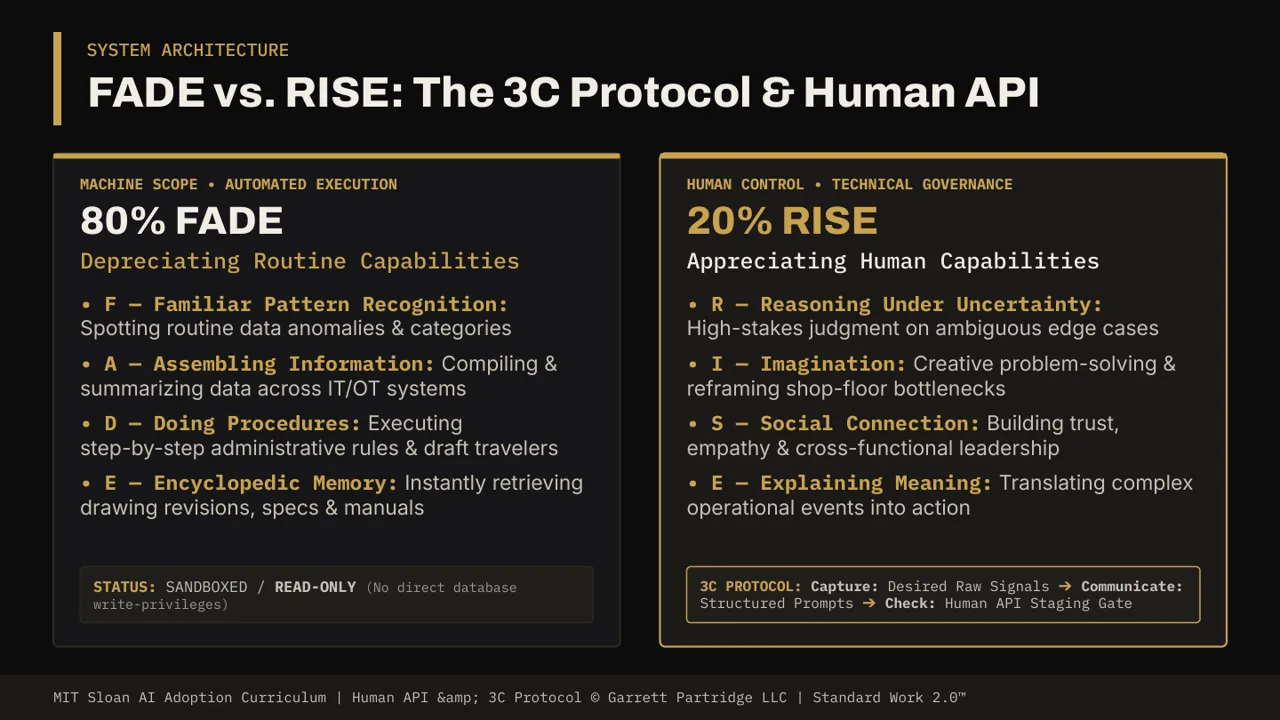
07 · System architecture
FADE vs. RISE: the 3C Protocol and Human API
Machines take the routine 80%. People keep the 20% that appreciates: reasoning, imagination, connection, and explaining meaning.
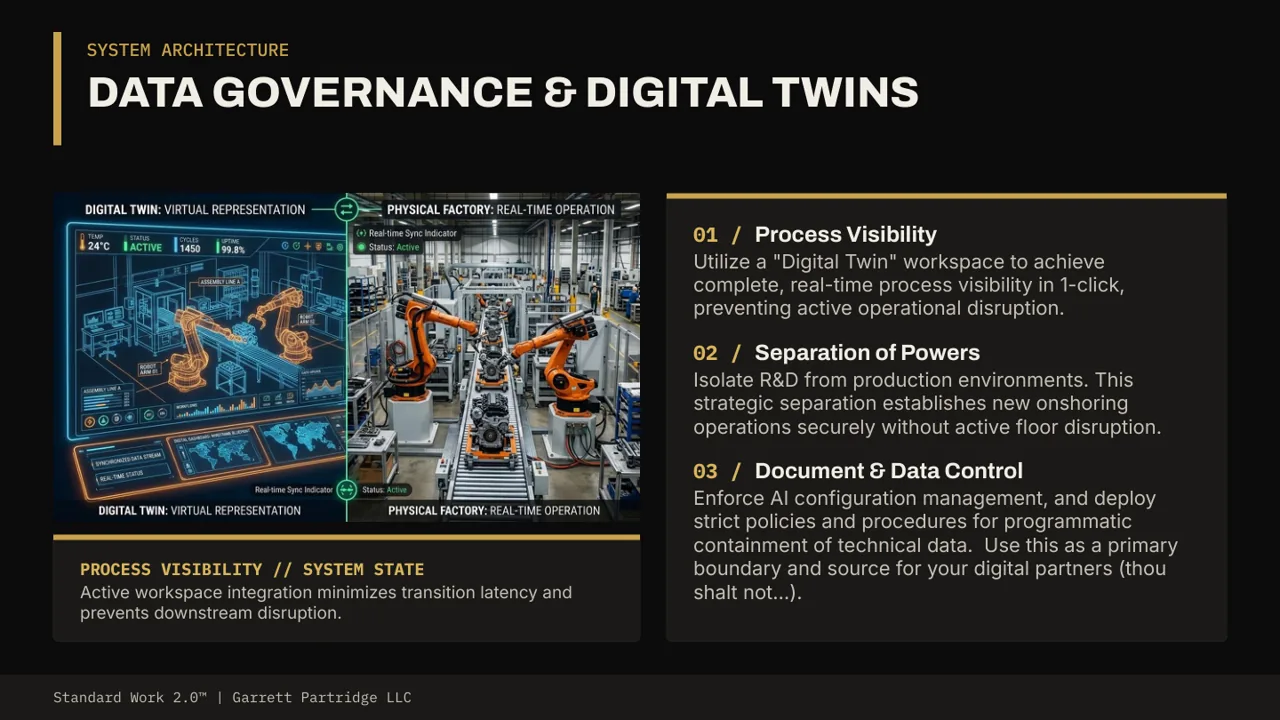
08 · Data governance
Digital twins and system state
One-click process visibility, R&D separated from production, and AI configuration under document control.
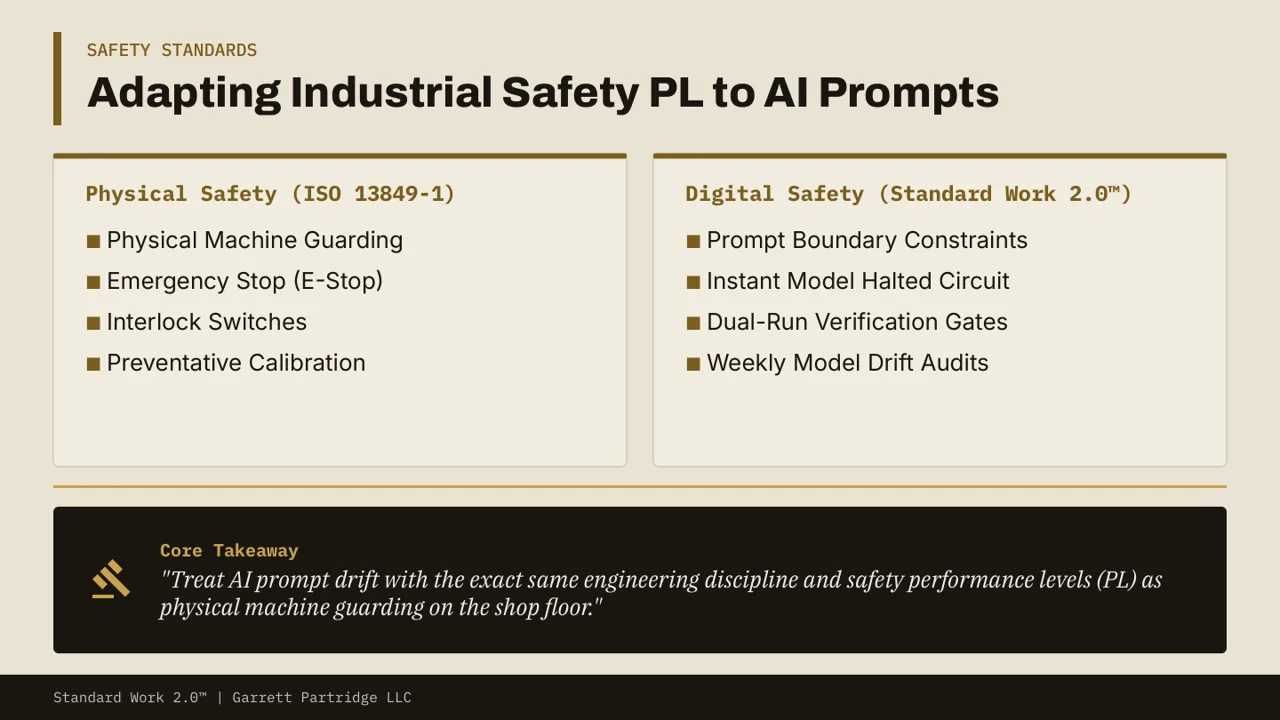
09 · Safety standards
Industrial safety PL, applied to AI prompts
Prompt drift gets the same discipline as machine guarding: boundary constraints, a halt circuit, dual-run verification, weekly drift audits.
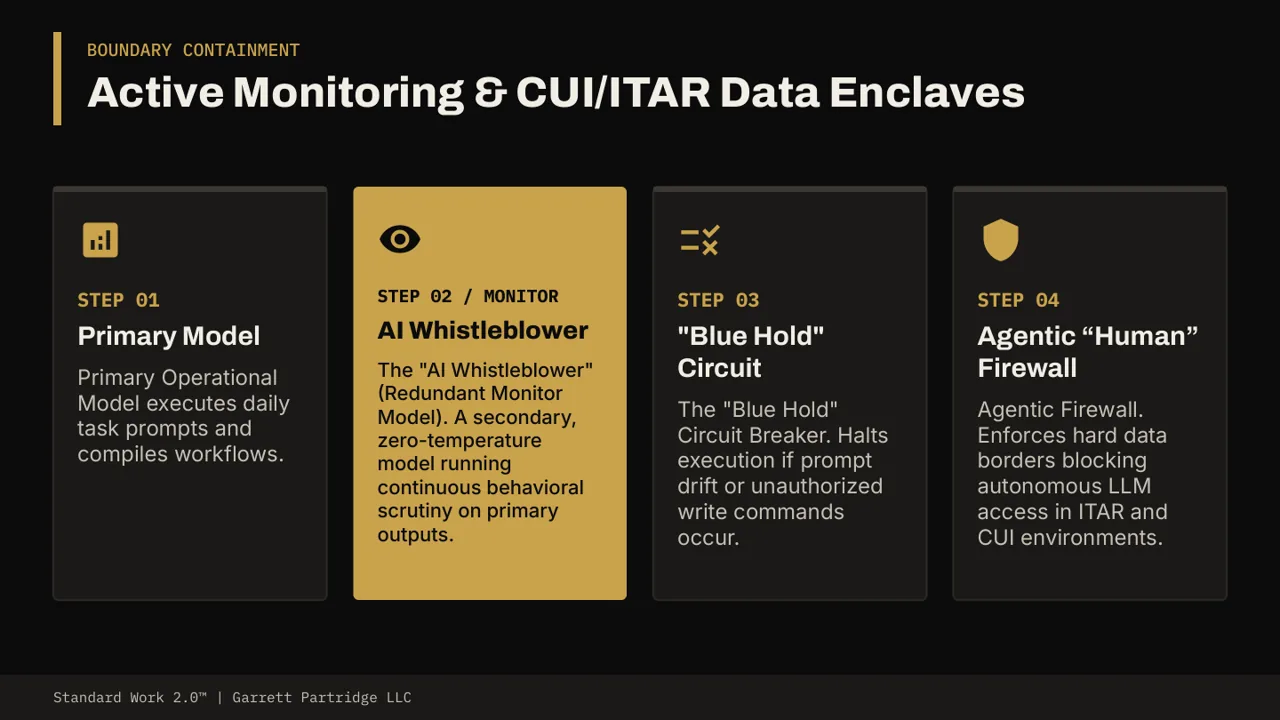
10 · Boundary containment
Active monitoring and CUI/ITAR data enclaves
A primary model, an AI Whistleblower monitor, a Blue Hold circuit breaker, and an agentic firewall at the ITAR and CUI border.
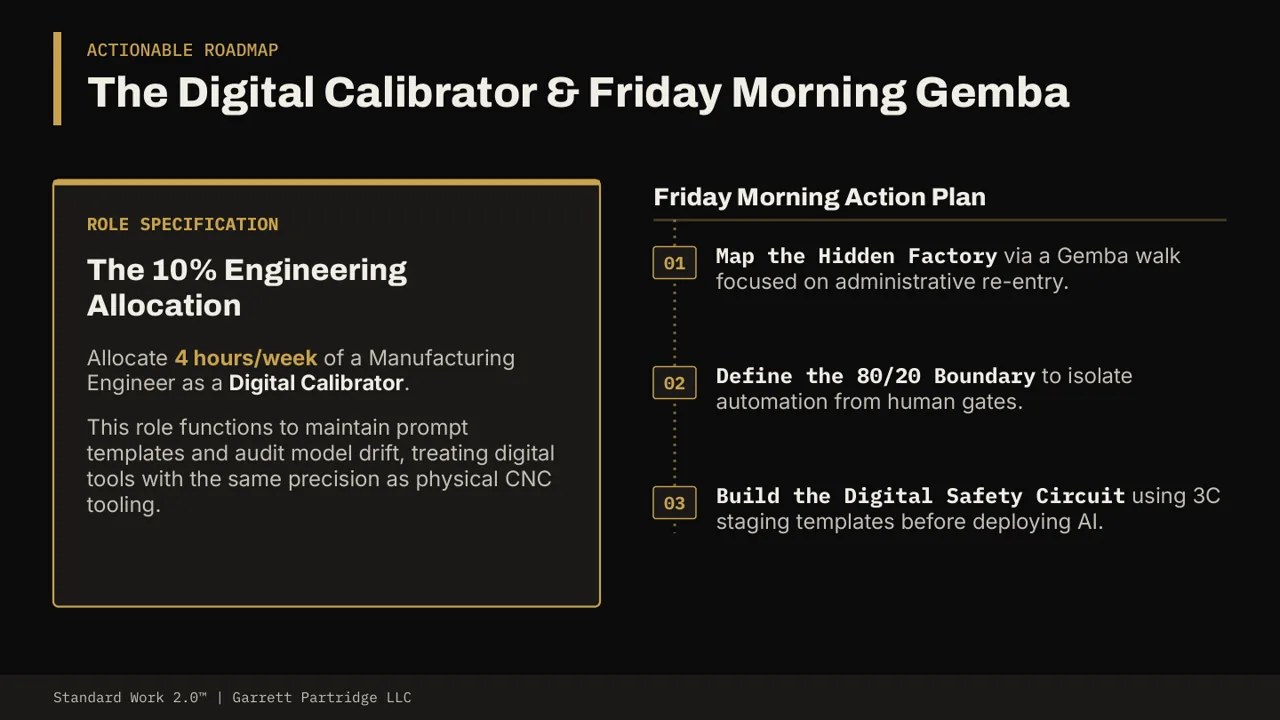
11 · Actionable roadmap
The Digital Calibrator and Friday Morning Gemba
Four hours a week of one manufacturing engineer keeps prompt templates calibrated and model drift audited, like CNC tooling.
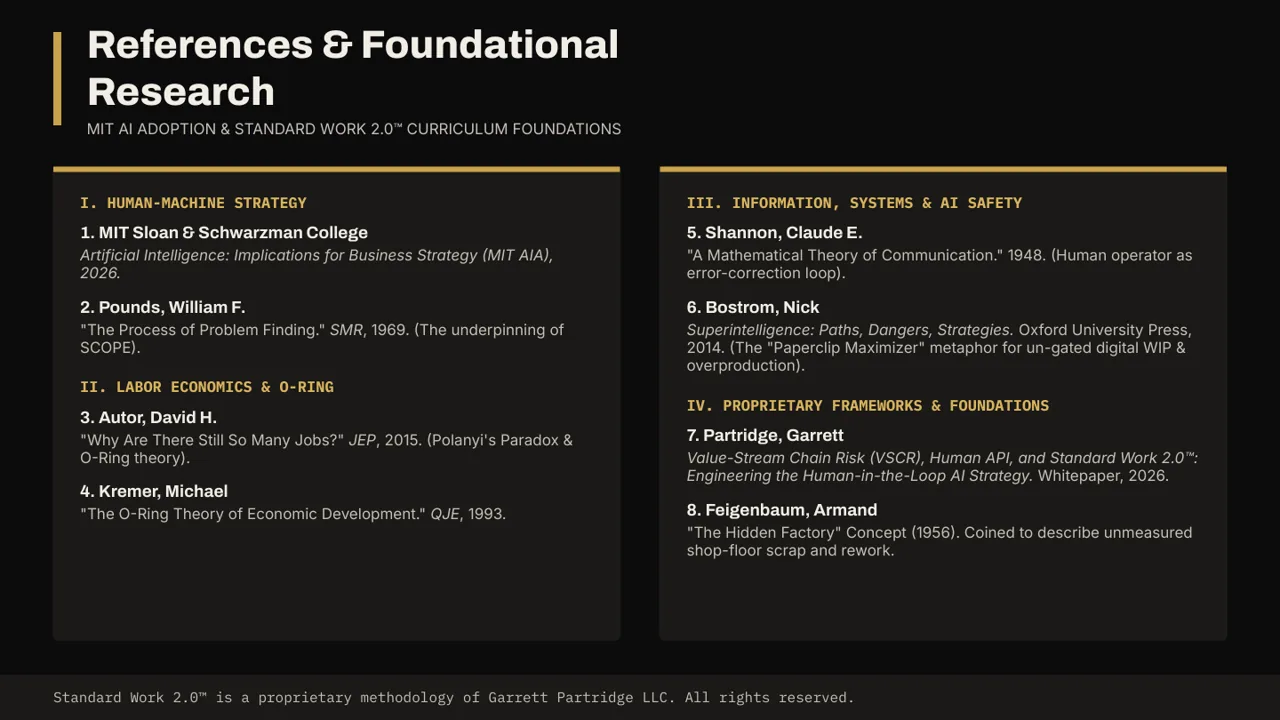
12 · References
Foundational research
MIT Sloan, Autor, Kremer, Shannon, Bostrom, Feigenbaum, and the Standard Work 2.0™ whitepaper.
PDF · 13 slides · 0.8 MB · free, no form
The Friday Morning Action Plan
Three moves before any AI touches the floor
The talk closed on one page of homework. It is where every engagement starts.
- 01
Map the Hidden Factory
Walk the Gemba with one question: where does the same data get typed twice?
- 02
Define the 80/20 boundary
Decide which work the machine runs and where a human gate stays mandatory.
- 03
Build the digital safety circuit
Stand up 3C staging templates (Capture, Communicate, Check) before deploying AI.
Put the plan to work on your floor
A shop-floor diagnostic starts at step one. We find where your Hidden Factory is eating capacity, where the 80/20 line belongs, and which gates go in before AI goes live.
Prefer to self-assess first? Run the six-question operational diagnostic
Schedule a Shop-Floor Diagnostic
Pick a time that works. Thirty minutes, and you leave with a first read on your floor.
Strategic conversation, 30 minutes
Only dates with openings can be selected.